Online Seminar: FPGA and Adaptive SoC Design Automation with AMD Ross Agentic AI
22-10-2026
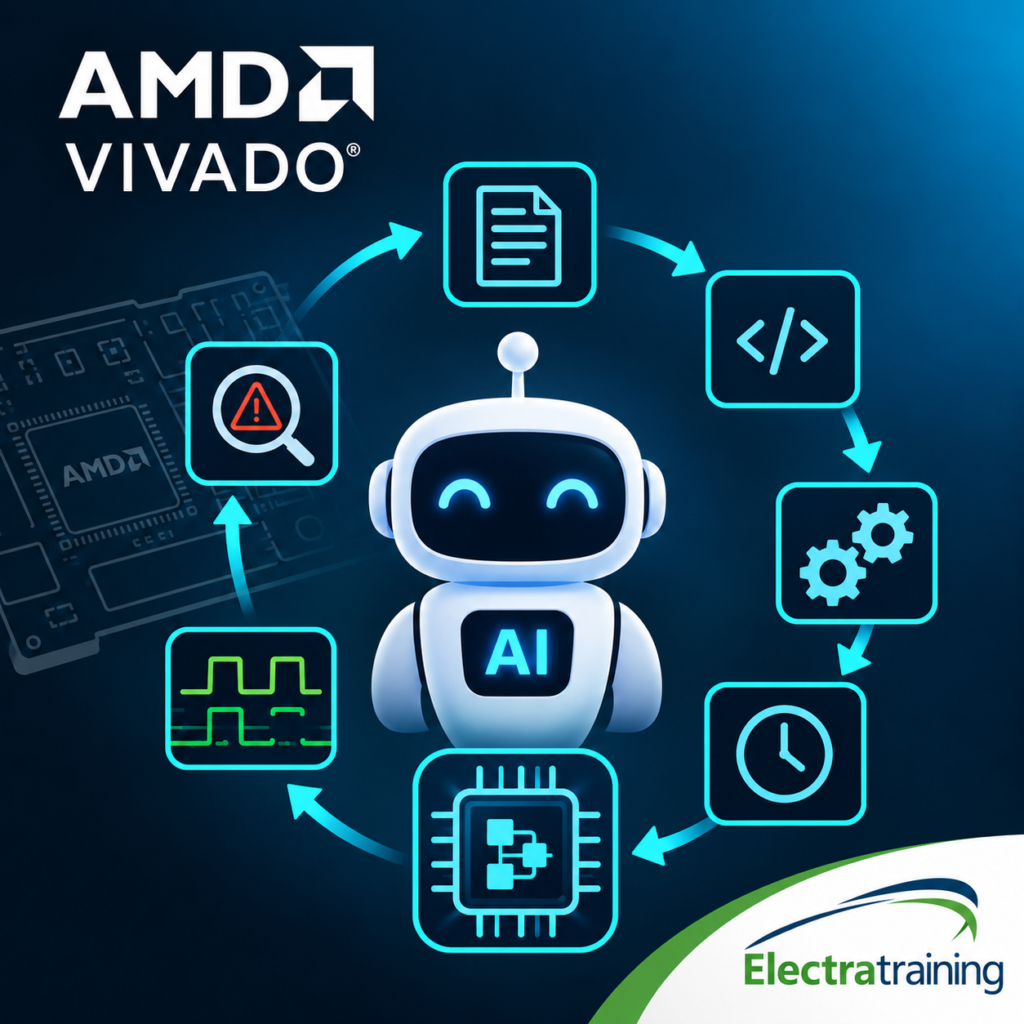


Seminario online: FPGA and Adaptive SoC Design Automation with AMD Ross Agentic AI
Automating design, implementation and debug workflows with AMD Ross Vivado AI Assistant.
Presentación (In English below):
La IA agéntica está cambiando la forma en que los ingenieros interactúan con herramientas de diseño complejas. Mediante la combinación de Grandes Modelos de Lenguaje (LLM), conocimiento de ingeniería, herramientas y flujos de trabajo automatizados, los agentes de IA pueden asistir a los diseñadores de FPGA a lo largo de todo el proceso de desarrollo.
Este workshop introduce los conceptos fundamentales de la IA agéntica y muestra cómo pueden aplicarse al desarrollo con FPGA utilizando AMD Vivado y la extensión Vivado AI Assistant.
Los participantes aprenderán cómo tecnologías como Retrieval-Augmented Generation (RAG), Model Context Protocol (MCP), la ingeniería de contexto y las skills reutilizables de IA permiten a los agentes interactuar con las herramientas de diseño y automatizar tareas de ingeniería.
Las demostraciones prácticas mostrarán el uso de IA agéntica para la creación de diseños FPGA, análisis RTL, resolución de errores, implementación y análisis de timing, así como para la depuración de hardware mediante Integrated Logic Analyzer (ILA).
El workshop también abordará las ventajas y limitaciones de los modelos avanzados basados en la nube frente a los LLM locales o desplegados on-premises, así como distintas técnicas para crear flujos de ingeniería asistidos por IA que sean fiables y deterministas.
Introduction (In English):
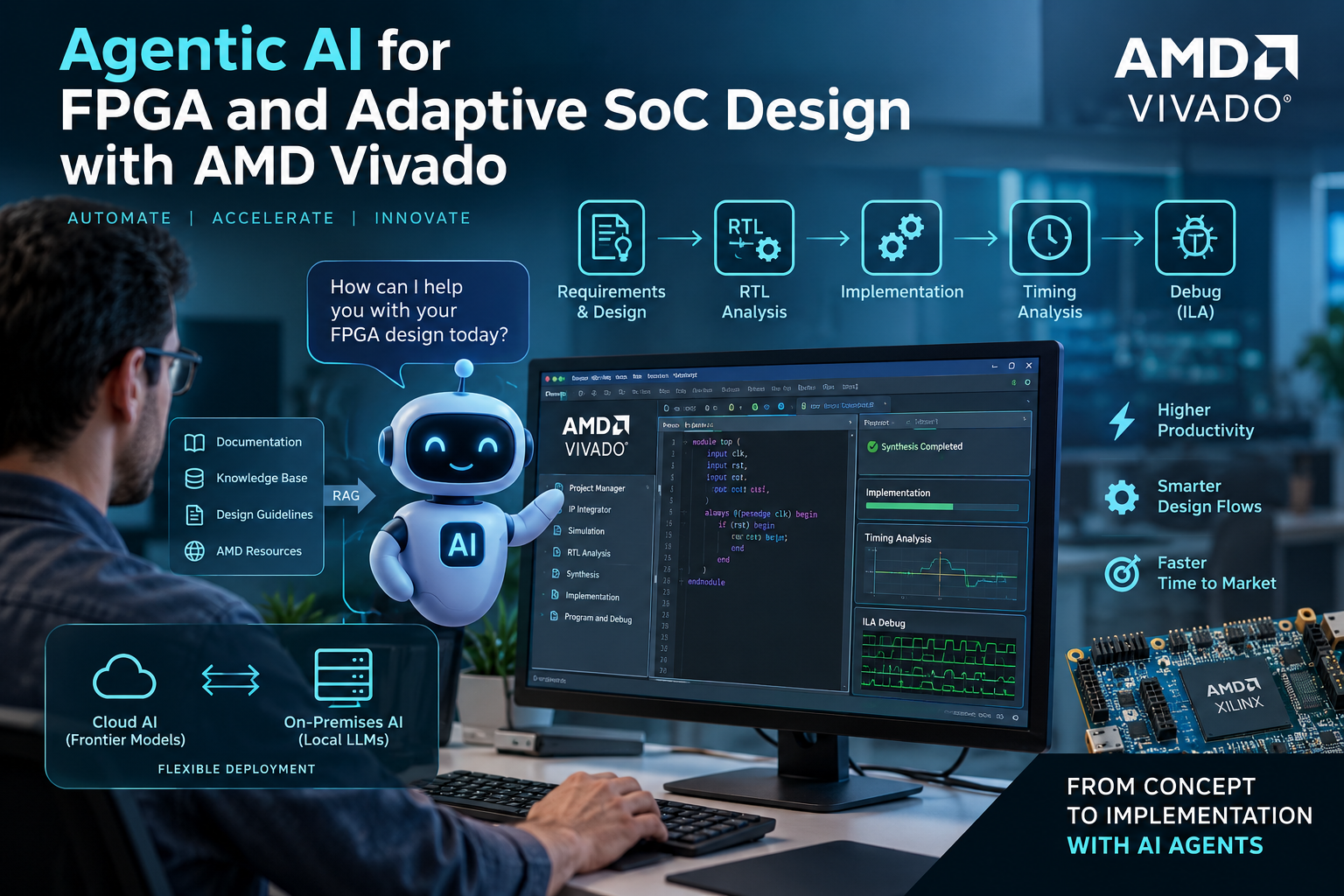
Agentic AI is changing the way engineers interact with complex design tools. By combining Large Language Models (LLMs), engineering knowledge, tools, and automated workflows, AI agents can assist FPGA designers throughout the development process.
This worshop introduces Agentic AI concepts and demonstrates how they can be applied to FPGA development using AMD Vivado and the Vivado AI Assistant Extension.
Participants will learn how technologies such as Retrieval-Augmented Generation (RAG), Model Context Protocol (MCP), context engineering, and reusable AI skills enable agents to interact with design tools and automate engineering tasks.
Practical demonstrations will show the use of Agentic AI for FPGA design creation, RTL analysis, error resolution, implementation and timing analysis, and hardware debugging using Integrated Logic Analyzer (ILA).
The workshop will also discuss the trade-offs between cloud-based frontier models and local/on-premises LLMs, as well as techniques for creating reliable and deterministic AI-assisted engineering workflows.
Throughout the workshop, real-world application examples such as industrial control, embedded vision, communications, and data processing are used to illustrate design trade-offs and architectural choices. The session concludes with a short demonstration and a live Q&A, ensuring participants leave with a clear understanding of how to effectively start designing with Spartan UltraScale+ and Kintex UltraScale+ Gen2 devices.
The seminar will be in Spanish.
Descriptores preliminares / Agenda (preliminary):
- Welcome and Introduction
- From Generative AI to Agentic AI: models, agents, tools, and orchestration
- Context engineering and Retrieval-Augmented Generation (RAG) for FPGA design knowledge
- Using Model Context Protocol (MCP) to connect AI agents with engineering tools
- Overview of the AMD Vivado AI Assistant Extension
- Interaction between AI agents and the AMD Vivado design flow
- Cloud-based frontier models versus local/on-premises LLMs
- Using skills and structured workflows to improve reliability and reduce hallucinations
- Closed-loop workflows for detecting, analyzing, and resolving design errors
- AI-assisted RTL analysis and design automation
- AI-assisted timing analysis and design optimization
- Automated insertion and configuration of Integrated Logic Analyzer (ILA) probes
- Practical demonstrations of Agentic AI applied to FPGA design and debugging
- Q&A
Fecha / Date:
Jueves 22 de octubre de 2026 de 15:00 a 18:00h. (horario coordinado Europeo de verano)
Thursday, october 22th 2026 15:00 – 18:00 CEST.
Lugar de realización / Place:
Live on Line